

Table of Contents
- Why Network Security Matters for Accounting Firms
- Top Network Security Solutions for Accounting Firms
- 1. Palo Alto Networks Next-Generation Firewalls
- 2. CrowdStrike Falcon for Endpoint Protection
- 3. Cisco Meraki MX Security Appliances
- 4. Sophos Intercept X with Ransomware Defense
- 5. Fortinet FortiGate for High-Performance Networks
- 6. SonicWall TZ Series for SMB Accounting Practices
- 7. WatchGuard Firebox with Centralized Management
- Security Features Comparison Table
- Cybersecurity Compliance for Accounting Firms
- Managed IT Services for CPAs
- How to Select the Right Security Solution
- Common Security Mistakes Accounting Firms Make
- Frequently Asked Questions
Last Updated: September 1, 2026
Why Network Security Matters for Accounting Firms
Accounting firms handle sensitive financial data, tax records, and client information that makes them prime targets for cybercriminals. A single breach triggers regulatory investigations, client lawsuits, and operational shutdowns costing months to recover from. Ransomware attacks on professional services firms have increased substantially, with attackers specifically targeting accounting practices because they know firms will pay to recover encrypted client files.
Network security for accounting firms 2026 requires building a security posture covering every layer: network perimeter, endpoints, data at rest, and data in transit. This guide covers solutions, compliance frameworks, and implementation strategies that separate firms with real security from those going through the motions.
Top Network Security Solutions for Accounting Firms
When evaluating network security for accounting firms 2026, compare solutions across threat prevention capability, ease of management, scalability, and total cost of ownership.
1. Palo Alto Networks Next-Generation Firewalls
Palo Alto Networks NGFWs are the gold standard for enterprise-grade protection. These appliances inspect encrypted traffic, enforce application-level policies, and block threats before they reach your network. The WildFire cloud-based analysis engine automatically detonates suspicious files and identifies zero-day exploits within minutes.
Key capabilities:
- Deep packet inspection of encrypted and unencrypted traffic
- Application and user-based policy enforcement
- GlobalProtect for secure remote access
- Integration with Security Information and Event Management systems
- Threat prevention (IPS, antivirus, anti-spyware in one appliance)
Palo Alto requires skilled IT staff to configure properly and is best for accounting practices with 50+ employees or multiple office locations.
2. CrowdStrike Falcon for Endpoint Protection
CrowdStrike Falcon uses behavioral analysis and AI-driven detection to catch attacks in progress before they encrypt files or steal data. The cloud-native architecture runs lean on workstations and communicates with CrowdStrike’s cloud backend for real-time response, providing essential centralized visibility for firms with remote workers.
What it does:
- Next-generation antivirus with behavioral threat detection
- Endpoint Detection and Response (EDR) for advanced threat hunting
- USB device control to prevent data exfiltration
- Managed threat hunting through Falcon OverWatch (premium tier)
- Integration with SIEM and incident response workflows
Pair Falcon with a next-generation firewall like Palo Alto or Fortinet for defense-in-depth. Best for firms wanting lightweight, cloud-native endpoint protection with strong detection capabilities.
3. Cisco Meraki MX Security Appliances
Cisco Meraki MX combines unified threat management and SD-WAN in one appliance, managed from a cloud dashboard. For firms with multiple office locations or hybrid workforces, Meraki’s cloud-based management and auto-VPN simplify deployment significantly.
Core features:
- Unified Threat Management (firewall, IPS, antivirus, content filtering)
- SD-WAN for optimized application performance across locations
- Cloud-managed dashboard for centralized control
- Auto-VPN for secure site-to-site connectivity
- Built-in wireless on select models
Meraki’s threat prevention isn’t as sophisticated as Palo Alto’s but handles common threats well. Best for distributed accounting practices with multiple offices needing simple, cloud-managed security.
4. Sophos Intercept X with Ransomware Defense
Sophos Intercept X is built to stop ransomware using deep learning AI and CryptoGuard technology. It detects encryption attempts in real time and rolls back attacks before files are locked, addressing the #1 fear for accounting firm owners.
What it protects against:
- Ransomware encryption attempts (blocked before completion)
- Exploit attacks targeting unpatched software
- Endpoint Detection and Response for advanced threat investigation
- Root cause analysis to understand attack vectors
- Managed threat response services (premium tier)
Pricing scales reasonably for firms under 100 people. Best for accounting firms prioritizing ransomware protection with limited IT staff.
5. Fortinet FortiGate for High-Performance Networks
Fortinet FortiGate maintains security and speed. If your network handles high throughput, large file transfers, video conferencing, and cloud backups, FortiGate maintains performance even with advanced security features enabled.
Key capabilities:
- Threat Protection (IPS, antivirus, web filtering, application control)
- Secure SD-WAN for optimized application routing
- SSL inspection for encrypted traffic analysis
- FortiGuard Labs threat intelligence
- Integrated wireless and switching on select models
Best for accounting practices needing high-performance network security without sacrificing throughput.
6. SonicWall TZ Series for SMB Accounting Practices
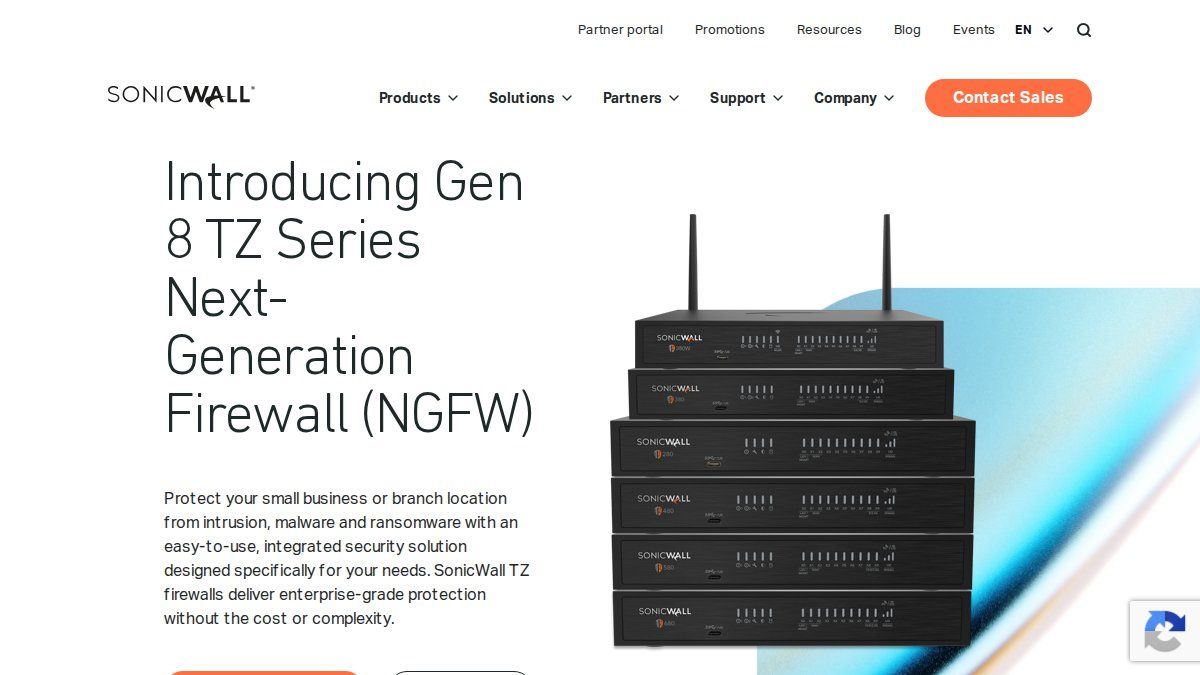
SonicWall TZ series firewalls are purpose-built for small and mid-sized businesses. Real-Time Deep Memory Inspection catches zero-day exploits by analyzing behavior in memory, not just file signatures.
What it includes:
- Deep Packet Inspection for encrypted and unencrypted traffic
- Real-Time Deep Memory Inspection for zero-day protection
- Secure SD-WAN capabilities
- Cloud-based management with SonicWall Capture Security Center
- Integrated wireless on select models
Best for small to mid-sized accounting practices (10-50 employees) needing comprehensive firewall protection without enterprise complexity.
7. WatchGuard Firebox with Centralized Management
WatchGuard Firebox appliances deliver unified threat management with emphasis on centralized control. The APT Blocker feature targets advanced persistent threats using behavioral analysis and threat intelligence.
Core features:
- Full UTM suite (intrusion prevention, gateway antivirus, anti-spam, web filtering)
- Advanced Persistent Threat (APT) Blocker
- Secure Wi-Fi capabilities
- Centralized management with WatchGuard Cloud
- SD-WAN functionality
Best for accounting firms seeking strong all-in-one security with centralized management and APT detection.
Security Features Comparison Table
| Solution | Best For | Standout Feature | Deployment Complexity |
|---|---|---|---|
| Palo Alto Networks NGFW | Enterprise-grade protection | WildFire zero-day analysis | High |
| CrowdStrike Falcon | Endpoint protection | Cloud-native, lightweight | Low |
| Cisco Meraki MX | Multi-location firms | Cloud dashboard simplicity | Low |
| Sophos Intercept X | Ransomware defense | CryptoGuard encryption blocking | Medium |
| Fortinet FortiGate | High-performance networks | Speed under load | Medium |
| SonicWall TZ | SMB accounting practices | Deep Memory Inspection | Low |
| WatchGuard Firebox | Centralized management | APT Blocker | Medium |
Cybersecurity Compliance for Accounting Firms
Network security for accounting firms 2026 requires meeting regulatory requirements governing how you handle client data. The IRS, state boards of accountancy, and clients’ compliance obligations create a mandatory framework.
IRS Security Six Requirements
The IRS Security Six is the baseline standard for tax professionals: strong password practices, Multi-Factor Authentication, secure data disposal, security awareness training, incident response planning, and regular software updates. Multi-Factor Authentication is non-negotiable, every user accessing client data must authenticate with something you have (password) plus something you are (biometric) or something you know (time-based code).
IRS Publication 4557 on safeguarding client data
AES-256 Encryption and Data Protection
Real encryption means AES-256 for data at rest, files stored on servers, backups, and archived records. This is the Department of Defense standard. Any backup solution, cloud storage, or file server should encrypt data with AES-256 by default.
Encryption keys matter as much as the algorithm. A strong encryption key stored in the same location as encrypted data provides no protection. Data in transit requires TLS 1.2 or higher for client files, emails, and remote access connections.
Multi-Factor Authentication Implementation
Time-based one-time passwords (TOTP) from authenticator apps like Google Authenticator are free and work offline. Hardware security keys (FIDO2) are more secure and faster but require distributing physical keys. Push notifications on mobile devices offer a middle ground, fast, secure, and no codes to type.
Start with TOTP for administrative accounts and client portal access. Migrate to push notifications or hardware keys as you scale. Most accounting firms find a hybrid approach works best.

Managed IT Services for CPAs
Accounting firms face a choice: hire an in-house IT person or partner with a managed IT services provider.
When to Choose Managed Services vs. Internal Teams
An in-house IT person costs 80,000-120,000 annually in salary plus benefits, equipment, and training. A managed IT services provider costs roughly the same but spreads expertise across a team with 24/7 monitoring instead of business-hours coverage.
For firms under 30 people, managed services typically make more sense. For firms over 50 people, an in-house person often becomes cost-effective. The hybrid approach, one in-house person plus managed services for after-hours monitoring and specialized projects, works well for mid-sized firms.
24/7 Monitoring and Incident Response
Real 24/7 monitoring means someone watches your network continuously. Automated alerts trigger the moment something looks wrong: unusual login patterns, failed authentication attempts, malware signatures, or data exfiltration attempts. A breach detected in 10 minutes instead of 10 hours is the difference between losing 100 client records and losing 10,000.
Incident response planning is critical. When an attack happens, you need a documented playbook: who to call, first steps, client notification procedures, evidence preservation, and assigned roles. Test these procedures quarterly.

How to Select the Right Security Solution
Choosing network security requires understanding your firm’s specific risk profile, not just picking the most popular tool.
Assessing Your Firm’s Risk Profile
Start with data inventory. What client information do you store? Tax returns, financial statements, W-2s, bank account details, social security numbers? Map your threat surface: how many users access sensitive data, how many external connections exist, and how many devices connect to your network?
Consider your firm’s attractiveness as a target. High-net-worth client base, multi-state practice, or clients in regulated industries increase risk. Finally, assess your IT capacity to deploy and manage advanced security tools.
Vendor Risk Management for Tax Portals
Most accounting firms use third-party tax software, client portals, and cloud storage. These vendors become part of your security architecture. Ask hard questions before signing contracts: Does the vendor encrypt data with AES-256? Do they conduct regular security audits? Can they provide SOC 2 Type II certification?
Reputable tax software companies publish security whitepapers. If your vendor won’t discuss security, consider alternatives.
Incident Response Planning
An incident response plan should include detection and analysis (how you identify breaches), containment (isolating infected systems), eradication (removing threats), recovery (restoring systems), communication (notifying clients and authorities), and documentation (preserving records for investigations).
Tabletop exercises where your team discusses hypothetical breach responses are more valuable than the document itself.
Common Security Mistakes Accounting Firms Make
Mistake 1: Treating security as a one-time project. Threats evolve constantly. Firmware updates, new threat intelligence, and employee training refreshes are ongoing requirements.
Mistake 2: Assuming the firewall is enough. Most breaches come from compromised employee credentials or malware on workstations. Network security requires defense-in-depth: firewall at the perimeter, endpoint protection on devices, encryption for data at rest, and access controls.
Mistake 3: Skipping employee training. Phishing emails trick employees into revealing passwords or opening malware attachments. Annual security training is baseline; phishing simulation is more effective.
Mistake 4: Using weak password practices. Shared passwords, written passwords, and password reuse are catastrophically common. Password managers like Keeper Security eliminate the need for users to remember complex passwords while enforcing strong policies.
Mistake 5: Neglecting backup and disaster recovery. Ransomware is only a threat if you lack clean backups. Maintain offline backups that attackers can’t encrypt and test your recovery process annually.
Mistake 6: Ignoring vendor risk. Your tax software, client portal, and cloud storage are part of your security perimeter. Understand who has access to your data and how they protect it.
The right network security for accounting firms 2026 combines technology, processes, and people. No single firewall or endpoint protection tool solves the problem. You need layered defenses, regular training, documented procedures, and ongoing monitoring. Firms treating security as continuous rather than one-time are the ones that sleep at night.
Computer Experts Corp helps accounting practices build comprehensive security posture. We assess your current risk profile, recommend solutions fitting your budget and IT capacity, and manage ongoing monitoring and updates so your team focuses on client work. Our 24/7 monitoring catches threats before they become breaches. Our incident response expertise gets you back to normal operations quickly.
NIST Cybersecurity Framework for small business guidance
State board of accountancy cybersecurity requirements
SOC 2 Type II compliance standards for service providers
Learn more about our services today and secure your firm’s network infrastructure for 2026 and beyond.
Frequently Asked Questions
Q: What are the essential cybersecurity requirements for accounting firms in 2026?
A: Accounting firms must comply with IRS Security Six requirements, which include Multi-Factor Authentication, data encryption using AES-256 standards, regular security awareness training, and incident response planning. Firms should implement firewall protection, antivirus solutions, and endpoint detection systems. Additionally, disaster recovery and business continuity planning are critical for protecting sensitive tax data and maintaining client trust.
Q: How do managed IT services improve network security for CPAs?
A: Managed IT services for CPAs provide 24/7 monitoring, threat detection, and incident response capabilities that many small accounting firms cannot afford internally. These services can include vulnerability assessments, security awareness training, firewall management, and data backup protocols. A managed service provider can handle endpoint detection and response, patch management, and compliance reporting, allowing your team to focus on client work. They also maintain current threat intelligence and adjust security posture as new threats emerge, reducing the risk of data breaches and regulatory violations.
Q: What is the difference between network firewalls and endpoint protection for accounting firms?
A: Network firewalls (like Palo Alto Networks or Cisco Meraki) protect your entire network perimeter by filtering incoming and outgoing traffic, blocking malicious connections, and preventing unauthorized access to your systems. Endpoint protection (like CrowdStrike Falcon or Sophos Intercept X) secures individual devices such as laptops, desktops, and servers by detecting and preventing malware, ransomware, and zero-day exploits at the device level. Both are essential: firewalls provide network-wide defense, while endpoint solutions protect against threats that bypass the firewall or originate from inside your network.
Q: Should accounting firms use cloud-based or on-premises network security?
A: Cloud-based security solutions like Cisco Meraki offer easier deployment, centralized management, and automatic updates, making them ideal for firms with multiple locations or limited IT staff. On-premises firewalls provide greater control and can be customized for specific compliance requirements. Many accounting firms benefit from a hybrid approach: cloud-managed firewalls for network perimeter defense and on-premises backup systems for disaster recovery. Your choice depends on your firm’s size, budget, technical expertise, and whether you have distributed offices or a single location.
This article was written using GrandRanker